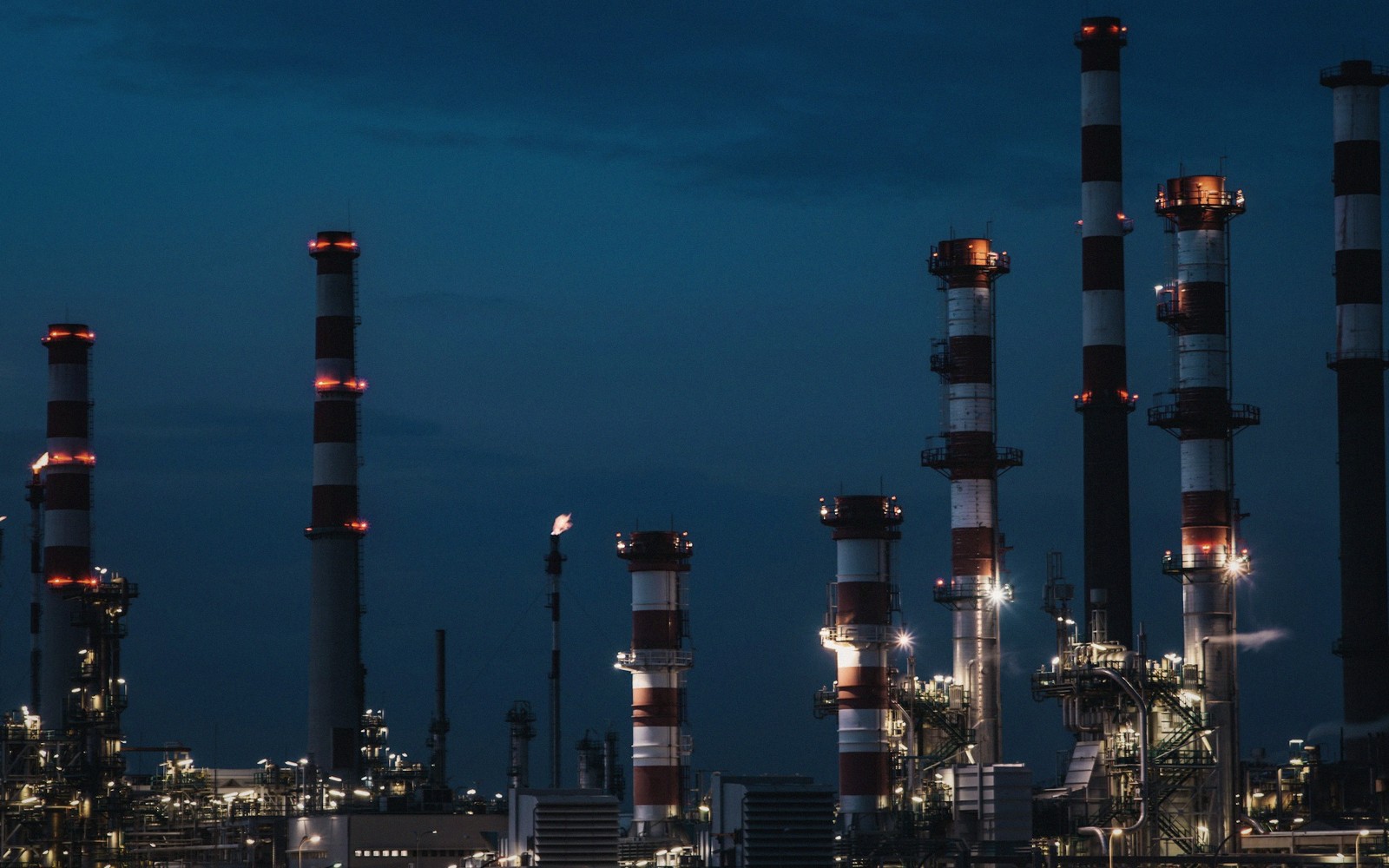
From wellhead to fuel tank — how crude becomes the products that move the world, stage by stage.
01Finding It and Getting It Out
Every barrel of oil begins as a geological question. Beneath certain rock formations — sedimentary basins laid down over millions of years — organic material was compressed and cooked by heat and pressure into hydrocarbons. The job of the upstream industry is to locate those accumulations, prove they are large enough to be worth developing, and bring them to surface.1
Exploration starts with seismic surveys. Trucks or ships send sound waves into the earth; sensors pick up the echoes bouncing back from different rock layers. Geoscientists read those reflections like a blurry medical scan, looking for the structural traps — anticlines, fault blocks, salt domes — where oil and gas tend to collect. Promising structures get drilled. Most exploration wells find nothing commercial; the ones that do trigger appraisal drilling to map the reservoir's extent before a final investment decision is made.
Once a field is sanctioned, development wells are drilled and production infrastructure is installed: wellheads, separators to strip out water and gas from the crude stream, and gathering pipelines to move fluid toward the next stage. The wellhead is, in a sense, the industry's birth certificate — the point at which oil becomes a commodity. Pressure in the reservoir often drives the first oil to surface under its own steam, but as a field matures, producers inject water or gas to maintain pressure, or deploy pumps to lift the remaining crude. How much of a reservoir's oil can ultimately be extracted — the recovery factor — depends on the rock, the fluid, and the techniques applied, and it varies enormously from field to field.
Offshore production adds layers of complexity and cost. Platforms or floating production vessels sit above the reservoir, and the crude must travel by pipeline or shuttle tanker to shore. Deepwater fields, in particular, require engineering at extreme pressure and temperature, which is why their development costs are among the highest in the industry.
02Moving It: The Midstream Layer
Once crude leaves the wellhead, it enters a world of pipes, pumps and tankers — the midstream. This is the connective tissue of the oil industry, largely invisible to consumers but essential to everything downstream.23
Pipelines are the workhorse of overland crude transport. A large trunk pipeline can move hundreds of thousands of barrels per day with relatively low energy cost per barrel-mile, which is why landlocked producing regions — Alberta, the Permian Basin in West Texas and New Mexico, the Russian interior — depend on them so heavily. Pipeline capacity, or the lack of it, can create significant regional price differentials: if production grows faster than pipes are built, producers may be forced to sell at a discount or wait.
Where pipelines are impractical — across oceans, or when demand patterns shift faster than infrastructure can follow — very large crude carriers (VLCCs) and other tanker classes take over. A VLCC can carry around two million barrels, and the global tanker fleet knits together producing regions and refining centres that could not otherwise be directly linked. Tanker rates fluctuate with the balance of supply and demand for shipping capacity, adding a further layer of price signal to the crude market.
Along the way, crude is gathered at tank farms and export terminals, blended to meet pipeline or buyer specifications, and tested for key characteristics: density (measured in API gravity) and sulphur content. These two dimensions — light or heavy, sweet or sour — are among the most important quality markers in oil trading, because they determine how a particular crude will behave in a refinery and what products it will yield most efficiently.
Different streams are blended to achieve the precise octane ratings, viscosities and cold-flow properties that end-use specifications demand.
03Refining It: Where Crude Becomes Products
A refinery is, at its core, a separation and conversion machine. Crude oil is a cocktail of hydrocarbons with wildly different molecular sizes and boiling points. The refinery's first job — atmospheric distillation — is to pull them apart by heat. As crude is heated in a distillation column, lighter fractions (smaller molecules, lower boiling points) rise and are drawn off near the top; heavier fractions settle lower. Gases, naphtha, kerosene, diesel and heavy fuel oil emerge from different levels of the column.
But simple distillation leaves a great deal of heavy material that nobody particularly wants, and relatively little of the high-value light products — gasoline and diesel — that the market demands most. This is where conversion units come in. A fluid catalytic cracker (FCC) breaks heavy molecules into lighter, more valuable ones. A hydrocracker does the same thing under high hydrogen pressure, producing very clean products. A coker handles the heaviest residue, turning it into lighter fuels and petroleum coke. Together, these units allow a sophisticated refinery to dramatically skew its output toward the most profitable products and to process cheaper, heavier crude grades that simpler plants cannot handle — a flexibility that carries real economic value.
The final stage is treating and blending. Sulphur must be removed from fuels to meet environmental specifications. Different streams are blended to achieve the precise octane ratings, viscosities and cold-flow properties that end-use specifications demand. What leaves the refinery gate is not crude in a different form, but an entirely new set of products: motor gasoline, jet fuel, diesel, heating oil, lubricants, asphalt, petrochemical feedstocks and more. A barrel of crude does not simply become a barrel of fuel — it becomes dozens of distinct commodities, each with its own market and its own supply chain.
Refinery configuration and location matter enormously. A coastal refinery in a major consumption region can source crude from global markets via tanker and distribute products locally. An inland refinery serving a landlocked market may be captive to regional crude supplies and face higher distribution costs for finished products. The global refining industry has become increasingly concentrated in large, complex facilities, because the economics of scale and conversion sophistication are decisive.
04Selling It: Downstream and the Final Mile
Products leaving the refinery enter the downstream distribution system — another network of pipelines, barges, trucks and terminals that ultimately connects to the consumer. Gasoline and diesel travel through product pipelines (kept scrupulously clean to prevent contamination between grades), to bulk terminals, and from there by road tanker to retail stations. Jet fuel moves similarly, with major airports served by dedicated hydrant systems fed from nearby storage. Heating oil travels to homes and commercial buildings; heavy fuel oil reaches power plants and bunker ports for shipping.
Petrochemical feedstocks — naphtha, ethane, propane — take a different path entirely. They feed steam crackers at chemical plants, where they are converted into ethylene, propylene and other building blocks for plastics, fertilisers, synthetic fibres and countless industrial materials. The oil industry and the petrochemical industry are, in this sense, deeply intertwined: a significant share of every barrel refined never becomes a fuel at all, but becomes the material world around us.
Retail fuel is the most visible part of this chain — the pump price that motorists watch closely — but it is also the end of a remarkably long and capital-intensive journey. The margin at the pump represents only a slice of the total value chain; the larger economic action happens upstream in exploration risk, midstream in infrastructure, and downstream in refinery complexity.
05The Chain as a System
What makes the oil industry worth understanding as a system, not just a sequence, is the way each stage is connected to every other. A disruption in upstream production ripples into midstream flows, refinery throughput and ultimately product availability. A refinery outage can tighten local fuel markets even when global crude supply is ample. A pipeline bottleneck can strand production and depress regional crude prices while refineries elsewhere go short. The upstream, midstream and downstream stages are interdependent in ways that are not always obvious from the outside.
Price signals travel both ways through the chain. When demand for jet fuel rises, refiners adjust their operating parameters to produce more of it; when a particular crude grade becomes cheaper, refiners formulate their purchasing to capture the margin. The crude benchmark prices — Brent, WTI and others — are a summary signal of what the whole system is doing, but the real action is in the dozens of differentials, spreads and product cracks that tell operators exactly where the value is moving on any given day.
The industry also carries enormous fixed-asset weight at every stage. Wells, pipelines, refineries and terminals are built over years and operated over decades. Capital decisions made today shape supply and infrastructure availability a decade from now. This long lag between investment and production — and between production and delivery — is one of the defining structural features of the oil market, explaining why it can be simultaneously cyclical in its finances and remarkably stable in its physical operation. The molecules keep moving, even when the money gets complicated.
Key players & places