Why the biggest oil companies own everything from the well to the forecourt
01The Logic of Integration
An oil major doesn't just find crude — it lifts it, ships it, refines it and sells the products. That span of activity, from exploration well to petrol station, is what makes a company "integrated," and it is no accident. The structure emerged over more than a century as a deliberate answer to a fundamental business problem: oil is a commodity whose price swings violently, but whose production costs are largely fixed. If you only do one thing along the chain, you are fully exposed to whatever the market hands you. If you do everything, the pain in one segment is often cushioned by gain in another.
The classic illustration is the relationship between the upstream and the downstream. When crude prices collapse, an exploration and production business bleeds — revenues crater while wells, rigs and staff still cost money. But a refiner buying that same cheap crude to make petrol and jet fuel can, for a time, expand its margin. The "crack spread" — the difference between the cost of crude and the value of refined products — often widens when oil is cheap, because product demand holds up better than the raw-material price. An integrated major captures both sides of that equation simultaneously. The upstream loss and the downstream gain don't perfectly cancel, but they smooth the ride considerably.123
The same logic runs in reverse. When crude prices surge, upstream operations print money, and refineries — now paying more for their feedstock — squeeze tighter. An integrated company absorbs both experiences at once. Over a full price cycle, the volatility of earnings is lower than it would be for a pure-play producer or a stand-alone refiner. For a business that must maintain capital expenditure through the cycle — drilling wells takes years of commitment, and refineries require continuous investment — that earnings stability is worth a great deal.
02What "Owning the Chain" Actually Means
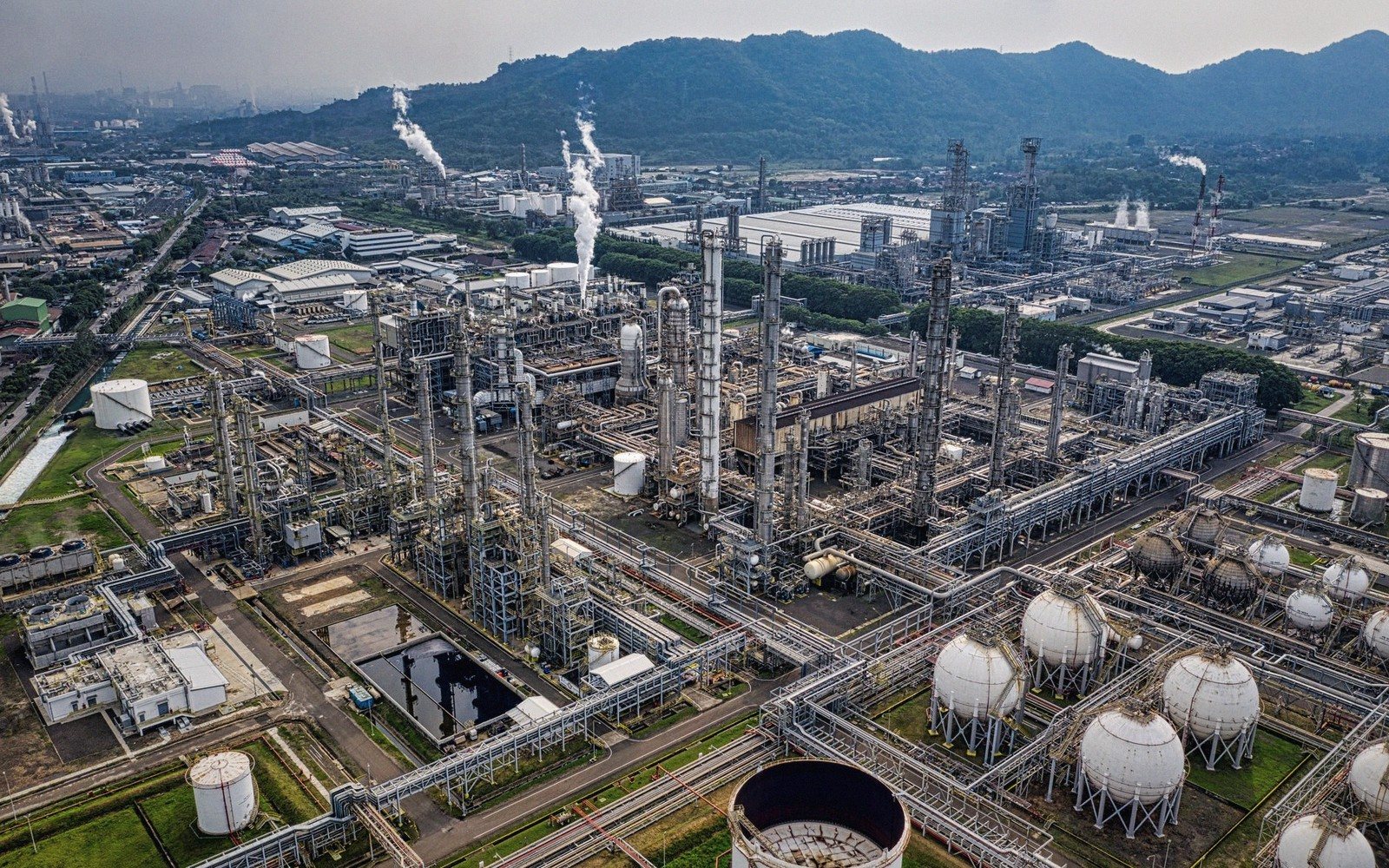
Integration is not merely a financial hedge; it is an operational system. Consider what has to happen between a molecule leaving a reservoir rock and landing in a car's fuel tank. Crude must be lifted, measured and treated at the wellhead. It travels by pipeline or tanker to a port or tank farm. It is traded, often multiple times, against benchmark prices. It enters a refinery, where distillation and cracking convert it into the precise blend of products the market wants. Those products then move through yet more pipelines and terminals into retail or industrial distribution. Each handoff involves price risk, logistics risk and quality risk.
A company that controls several stages of that chain can internalise those handoffs rather than negotiate them in the open market. Transfer pricing between divisions, priority access to shipping capacity, guaranteed feedstock supply for refineries, guaranteed offtake for production — these efficiencies are real, even if they are hard to quantify on a single line of a balance sheet. Midstream assets — pipelines, tankers, terminals — function as connective tissue, and the majors that own them reduce dependence on third-party infrastructure whose capacity and cost can be unpredictable.
The trading arm matters too. The integrated majors are among the largest traders of crude and products in the world, and that activity is not peripheral — it is integral to making the model work. Proprietary trading desks allow a major to optimise its own flows: routing crude to the refinery where the margin is highest that week, blending product specifications to meet the tightest market. The information advantage that comes from moving physical barrels every day also sharpens those trading decisions in ways a purely financial trader cannot replicate.
Over a full price cycle, the volatility of earnings is lower than it would be for a pure-play producer or a stand-alone refiner.
03The Limits of the Model
Integration is not a free lunch. Owning the whole chain requires enormous capital — refineries alone represent multi-billion-dollar commitments — and the returns on downstream assets are structurally lower than the returns on a world-class upstream position. A supergiant field is a gift that keeps giving for decades; a refinery is a complex, competitive, margin-thin processing business in a market that frequently oversupplies capacity. Some majors have, at various points, argued that the diversification benefit of the integrated model is outweighed by the capital drag of maintaining low-return downstream assets, and have trimmed or restructured their refining portfolios accordingly.
Geography also complicates integration. A company's upstream assets may be concentrated in one region while its refining capacity sits in another, and the crude quality it produces may not be the optimal feedstock for its own refineries. Logistics and crude-quality mismatches mean that integration on paper does not always translate into seamless operational synergy in practice.
And yet, cycle after cycle, the largest firms in the industry have largely retained the integrated structure — because the alternative, pure specialisation, leaves a company with nowhere to shelter when its single segment turns hostile. The integrated model is, at its core, a bet that stability has value: that the ability to keep investing through a down-cycle, to retain the workforce, to maintain the assets, pays back more over time than the peak returns a focused pure-play might capture in a favourable market. The history of the industry suggests that bet has been a reasonable one.