01Turning Crude Into Product
A barrel of crude oil is not particularly useful on its own. It is a mixture of hydrocarbons — light, heavy, volatile, viscous — and it only becomes the fuels, feedstocks and chemicals that the modern economy runs on once it has been processed. That processing happens inside a refinery, and the location, capacity and configuration of the world's refining infrastructure shapes how oil markets function almost as much as production itself.
Refineries are industrial complexes that separate crude into fractions by boiling point, then upgrade and recombine those fractions into saleable products: gasoline, diesel, jet fuel, fuel oil, liquefied petroleum gas, asphalt and a long list of petrochemical feedstocks. The first step — atmospheric distillation — is essentially a very controlled version of the same principle that separates any mixture of liquids. What follows is more complex: cracking units break heavy molecules into lighter, more valuable ones; reformers rearrange molecular structures to boost octane; hydrotreaters remove sulfur to meet emissions standards. A simple refinery can do the first step and little else; a complex, highly upgraded refinery — the kind measured by a metric called the Nelson Complexity Index — can squeeze more high-value product from a barrel of cheap, heavy or sour crude.1
That complexity is commercially important. A refinery with significant upgrading capacity can profit from buying discounted heavy crude and processing it into premium products. One without that capability is more constrained, limited largely to lighter, sweeter feedstocks. This is partly why refining margins — the difference between the cost of crude and the value of the products made from it — can vary dramatically between facilities even when they sit in the same region and process similar volumes.
Refining capacity is unevenly distributed globally. Large concentrations sit close to major demand centres — the United States Gulf Coast, Western Europe, the Asian refining hubs of India, South Korea, China and Singapore — but there has been a sustained shift over recent decades toward capacity in producer countries and in fast-growing Asian markets. Some traditional refining heartlands have seen capacity retire as margins tightened and demand patterns shifted; others have seen major new facilities commissioned to serve export markets.
02Tanks, Terminals and the Art of Storage
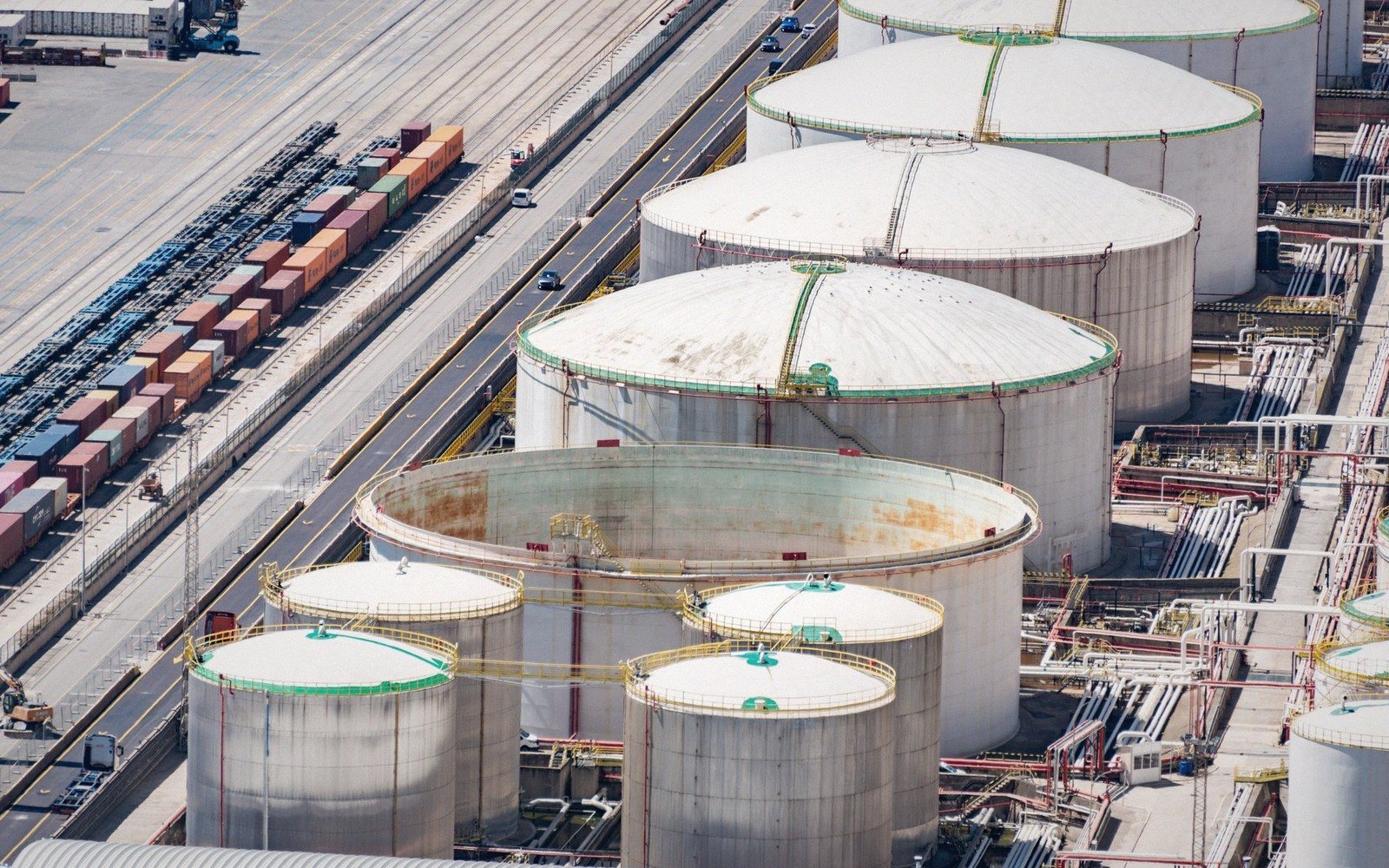
Once product leaves the refinery, it does not always go directly to the end user. It moves into a network of storage — tank farms, distribution terminals, pipeline breakout tanks, port facilities — that acts as a buffer between the continuous flow of production and the lumpy, seasonal, geographically uneven pattern of demand. This infrastructure is the unglamorous middle layer of the supply chain: it rarely makes headlines, but its constraints shape price signals in quiet, persistent ways.
Tank farms cluster around refineries, pipeline junctions and deep-water ports. Crude storage and product storage are distinct — crude tanks feed refineries, while product tanks hold finished gasoline, diesel or jet fuel awaiting distribution. The aggregate level of commercial inventories, particularly in major trading hubs like Cushing, Oklahoma (the delivery point for WTI crude futures) or the ARA region around Antwerp, Rotterdam and Amsterdam, is watched closely by traders because it is a direct indicator of near-term supply and demand balance. When inventories build, it signals supply is running ahead of demand; when they draw down, the reverse.
Storage economics introduce a peculiarity that traders call contango. When near-term crude prices are lower than prices for future delivery, it becomes profitable to buy physical crude, store it and sell it forward at the higher price — provided storage costs and financing charges are covered by the price differential. This condition, contango, effectively turns storage tanks into a financial instrument. The opposite condition, backwardation, discourages storage and pulls crude onto the market quickly.23
When inventories build, it signals supply is running ahead of demand; when they draw down, the reverse.
03Strategic Reserves: The Insurance Policy
Beyond commercial storage sits a different category entirely: strategic petroleum reserves (SPRs), held by governments rather than companies and designed not for trading but for crisis response. The logic is simple — oil supply can be disrupted by conflict, natural disaster, infrastructure failure or producer action, and a large economy with no buffer is acutely vulnerable during the weeks or months it might take for alternative supply to arrive.
The United States Strategic Petroleum Reserve, stored in salt caverns along the Gulf of Mexico coastline, is among the largest government-held reserves in the world. Member countries of the International Energy Agency (IEA) are required under treaty to maintain strategic stocks equivalent to roughly ninety days of net imports, and coordinated releases from those stocks have been used on several occasions to calm markets during supply disruptions.
Strategic reserves are not a long-term supply solution — they are a shock absorber, not a replacement for production. Their release signals intent as much as it delivers volume; the announcement alone can move prices by signalling that governments are willing to act. Together with commercial storage and refining capacity, they form the physical infrastructure that gives the oil system its resilience — the difference between a supply disruption and a genuine crisis.
Key players & places