01From Crude to Components
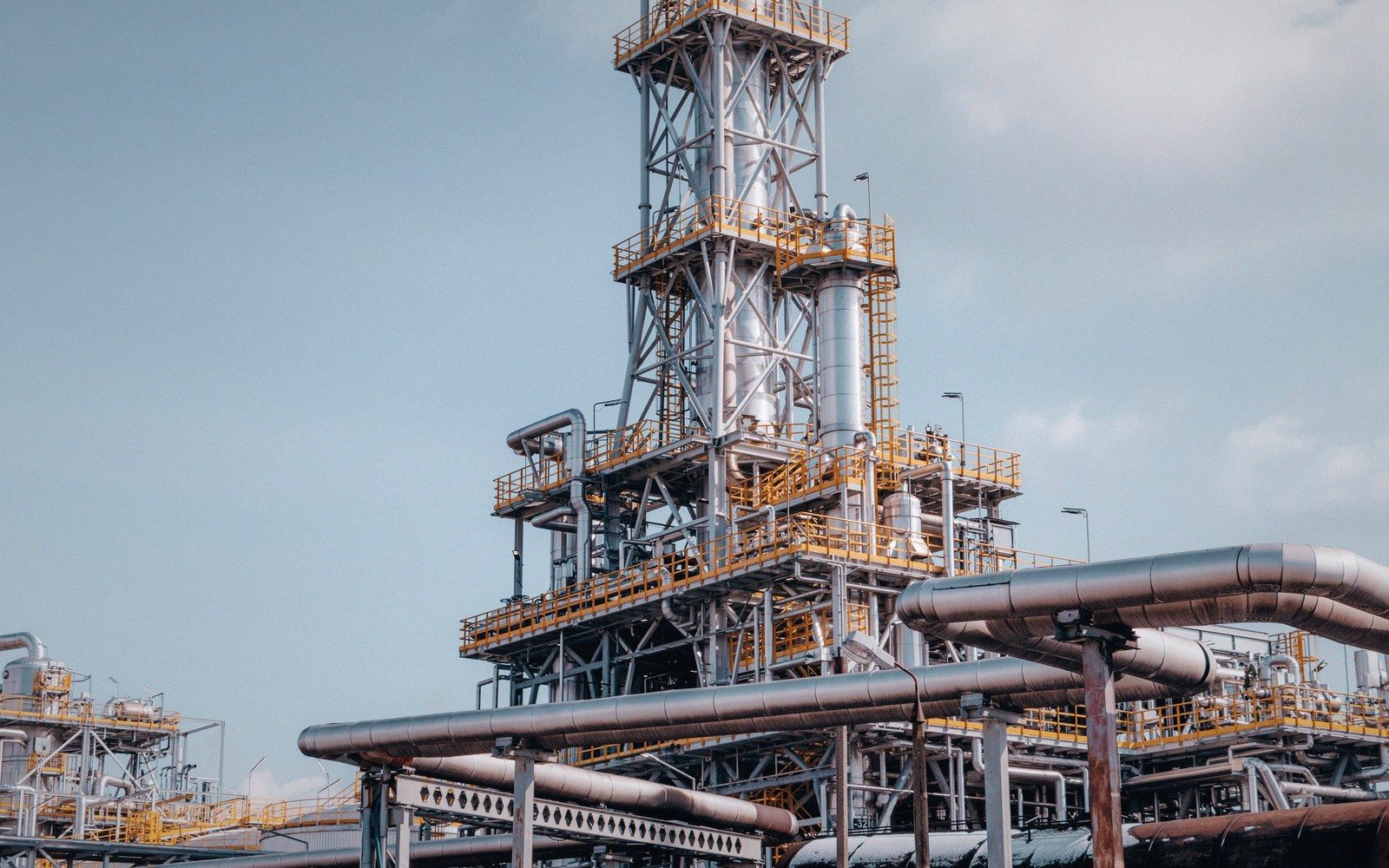
A barrel of crude arrives at a refinery as a cocktail of thousands of different hydrocarbon molecules, each with its own boiling point, density and commercial value. The first task is simply to separate them. That separation happens in a distillation column — a steel tower that can stand taller than a fifteen-storey building, running continuously, twenty-four hours a day.
The process is called atmospheric distillation, and it works on a beautifully simple principle: heat the crude, and each hydrocarbon fraction vaporises at a different temperature. Light gases rise to the top of the column, where it's coolest. Heavier fractions — kerosene, diesel, fuel oil — condense at successively lower levels as temperatures climb toward the bottom. Each fraction is drawn off at the right height and piped away for further treatment. What remains at the very base of the column after all the vapours have risen is a thick, tar-like residue called the bottom of the barrel — literally.1
The trouble is that the natural proportions of these fractions rarely match what the market wants. A typical barrel of crude yields far more heavy fuel oil than it does gasoline, but demand runs the other way. Refiners need a way to rearrange the molecules nature handed them. That's where cracking comes in.
02Cracking, Reforming, Blending
Cracking is exactly what it sounds like: breaking large, heavy hydrocarbon chains into smaller, lighter, more valuable ones. The dominant process in most modern refineries is fluid catalytic cracking, or FCC. Hot vapour from the distillation unit is mixed with a fine powdered catalyst and held at extreme heat, causing the heavy molecules to fragment into the shorter chains that make up gasoline and diesel. The catalyst itself is continuously circulated, burned clean in a regenerator, and fed back into the process — a loop that never stops.2
Hydrocracking does much the same job but under high pressure and in the presence of hydrogen, which produces a cleaner, higher-quality output — particularly useful for making low-sulphur diesel. The capital cost is higher, so hydrocrackers tend to sit in refineries built to handle heavy, sulphur-rich crudes where the extra investment pays off.3
Not every step is about breaking things apart. Reforming does the opposite: it takes low-octane naphtha — a light fraction with limited use straight from the distillation column — and rearranges its molecules into higher-octane compounds. The output, called reformate, is a key blending component for gasoline. Alkylation units perform another variation, combining small molecules into high-octane liquid fuel. Together, these processes give a refinery the flexibility to tune its output to the season, the market and the crude slate it's running.
Blending is the final act. Gasoline, for instance, leaves the refinery not as a single pure compound but as a carefully proportioned blend of reformate, alkylate, FCC gasoline and additives — including ethanol in many markets. The exact recipe varies by region (different countries mandate different specifications), by season (winter blends have a higher vapour pressure to help cold engines start), and by grade. Diesel is blended to meet cetane ratings and sulphur limits. Jet fuel must pass a raft of freeze-point and combustion tests before it goes anywhere near an aircraft.
What emerges from a large, complex refinery is a roster of products that would surprise most drivers: gasoline and diesel, certainly, but also jet fuel, liquefied petroleum gas, naphtha bound for petrochemical plants, bitumen for road surfaces, lubricant base oils, sulphur recovered as a by-product, and petroleum coke used as industrial fuel. A barrel yields more product types than most people realise.
Refinery complexity is measured by something called the Nelson Complexity Index — a single number that captures how much secondary processing capacity a plant has relative to its basic distillation throughput. A simple topping refinery might score a two or three; a full-conversion complex capable of handling the heaviest crudes and meeting the tightest fuel specifications might score fifteen or above. The higher the complexity, the greater the capital invested, the wider the crude diet the refinery can handle, and generally the higher the margin it can earn over the cost of the crude it consumes.
Cracking is exactly what it sounds like: breaking large, heavy hydrocarbon chains into smaller, lighter, more valuable ones.
- Atmospheric distillation — heating crude so hydrocarbon fractions separate by boiling point in a column ↩
- Fluid catalytic cracking (FCC) — process that breaks heavy hydrocarbons into lighter fuels using a catalyst ↩
- Hydrocracking — high-pressure, hydrogen-assisted cracking producing clean, low-sulphur fuels ↩