Gas goes global — how liquefaction turned a stranded resource into a traded commodity2
Natural gas has a problem that oil does not: you cannot easily put it in a tanker and ship it across an ocean. At room temperature and atmospheric pressure, gas is simply too voluminous to transport economically over long distances where no pipeline exists. Liquefied natural gas — LNG — solves that problem by shrinking the gas to about one six-hundredth of its original volume, making it dense enough to load onto a ship and carry anywhere in the world with a port deep enough to receive it.1
01Chilling it down: the liquefaction terminal
The process begins at an export terminal — often called a liquefaction plant or, in industry shorthand, a "train." Incoming pipeline gas is first cleaned: water, carbon dioxide, sulphur compounds and heavy hydrocarbons are stripped out, because any impurities that freeze at cryogenic temperatures would clog the equipment downstream. What remains is very nearly pure methane.3
That methane is then chilled, in stages, to roughly minus 162 degrees Celsius — the point at which it becomes a clear, odourless liquid. The cooling is done by refrigerant loops, typically using propane and mixed refrigerants in a cascade arrangement. The exact configuration varies: different licensors sell different process designs, but the thermodynamic principle is the same everywhere. Running all that refrigeration machinery demands enormous amounts of energy, which is why liquefaction terminals are among the most power-hungry industrial facilities on earth, and why a plant's own gas consumption — its "fuel and loss" — is a real cost that developers model carefully before sanctioning a project.
A single liquefaction train might process several million tonnes of LNG per year. Large export facilities stack multiple trains side by side, each an independent production line that can be brought on or taken offline without shutting the whole plant. This modularity matters: it lets operators manage maintenance without halting exports, and lets developers phase capital expenditure over time.
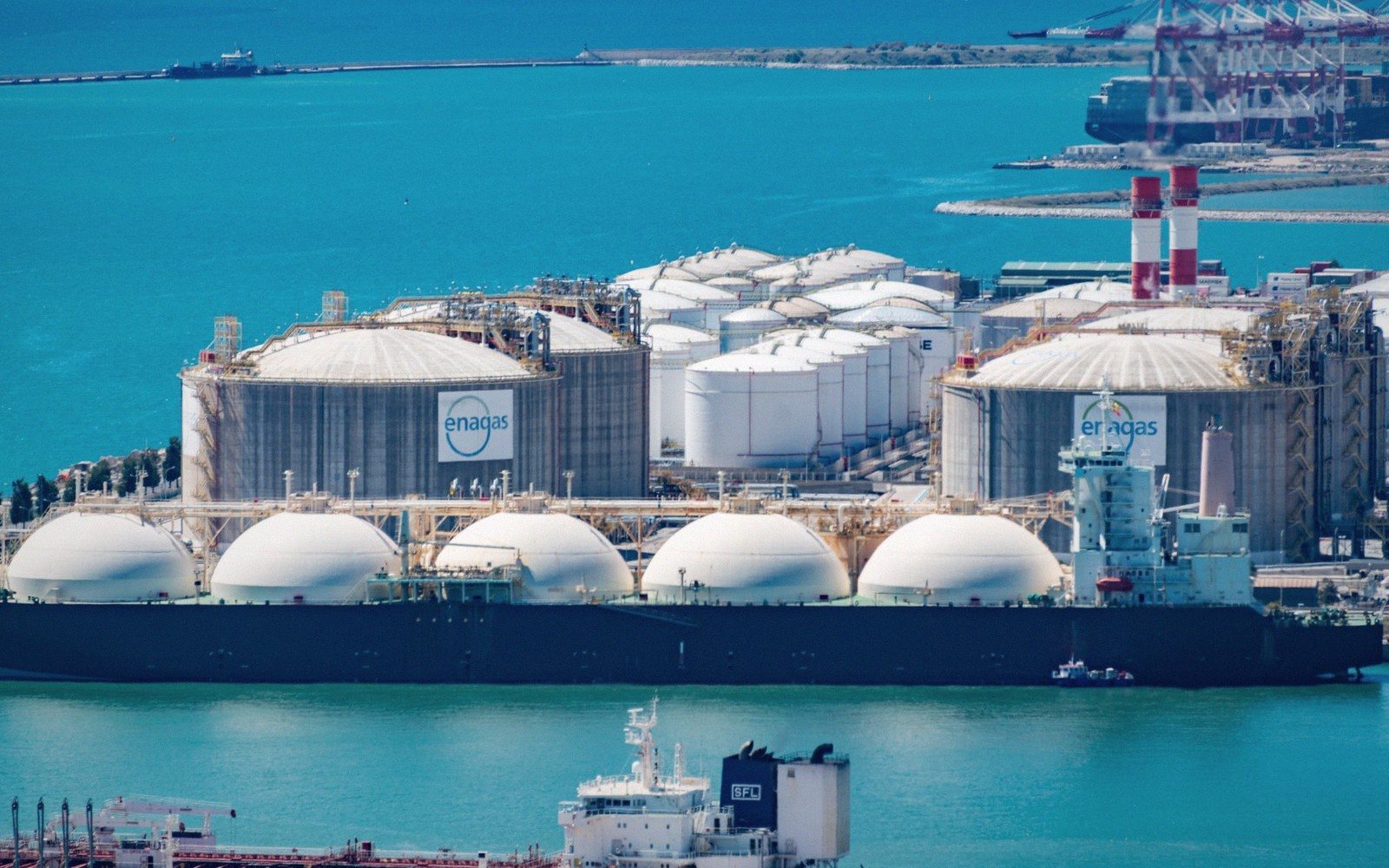
Once liquefied, the LNG is held in giant insulated storage tanks at the terminal — above-ground vessels with thick insulation walls that keep the liquid cold without continuous refrigeration, relying instead on the principle that the small amount of gas that naturally boils off acts as a self-cooling blanket. Loading arms transfer the liquid from tank to ship at the marine berth.
02Moving it: the LNG carrier
LNG carriers are among the most technically demanding vessels in commercial shipping. Their cargo tanks — either spherical Moss-type or membrane-type, depending on the builder — are designed to hold cryogenic liquid safely while the ship pitches through open ocean. The boil-off gas that evaporates during the voyage is not wasted: modern vessels burn it as fuel, sometimes supplemented by conventional marine fuel oil when boil-off alone is insufficient.
Voyage lengths vary enormously. A cargo from the US Gulf Coast to a buyer in Japan or South Korea crosses the Pacific; one from Qatar to Europe is shorter but still measured in days. The flexibility to redirect cargoes — to divert a ship mid-voyage toward a market offering a better price — is one of the defining features of the LNG trade, and it is what makes LNG genuinely global in a way that pipeline gas, locked into fixed routes, can never be.
LNG carriers are among the most technically demanding vessels in commercial shipping.
03Regasifying it: the import terminal
At the destination, an import terminal — a regasification facility — does the reverse. LNG is offloaded from the ship into storage tanks, then passed through vaporisers that warm it back into gaseous form. The heat source varies: some terminals use seawater, others burn a small fraction of the gas itself, and some use waste heat from nearby industrial processes. Once regasified, the methane enters the local pipeline grid and flows to power plants, industrial users and, eventually, households.
A growing share of regasification capacity is now provided by Floating Storage and Regasification Units — FSRUs. These are essentially ship-shaped terminals that can be moored offshore or in a harbour, avoiding the cost and time of building permanent onshore infrastructure. An FSRU can be deployed in months rather than the years a fixed terminal requires, making it an attractive option for countries entering the LNG market quickly.
04The chain as a whole
Liquefaction, shipping and regasification form an integrated chain, and a weakness anywhere disrupts the whole. Export terminals take years to permit and build; ships are ordered years in advance; import capacity must exist before a cargo has anywhere to go. The long lead times are why LNG trade is still largely structured around long-term contracts — though spot and short-term trading has grown substantially, adding the price flexibility that buyers increasingly demand.
Key players & places