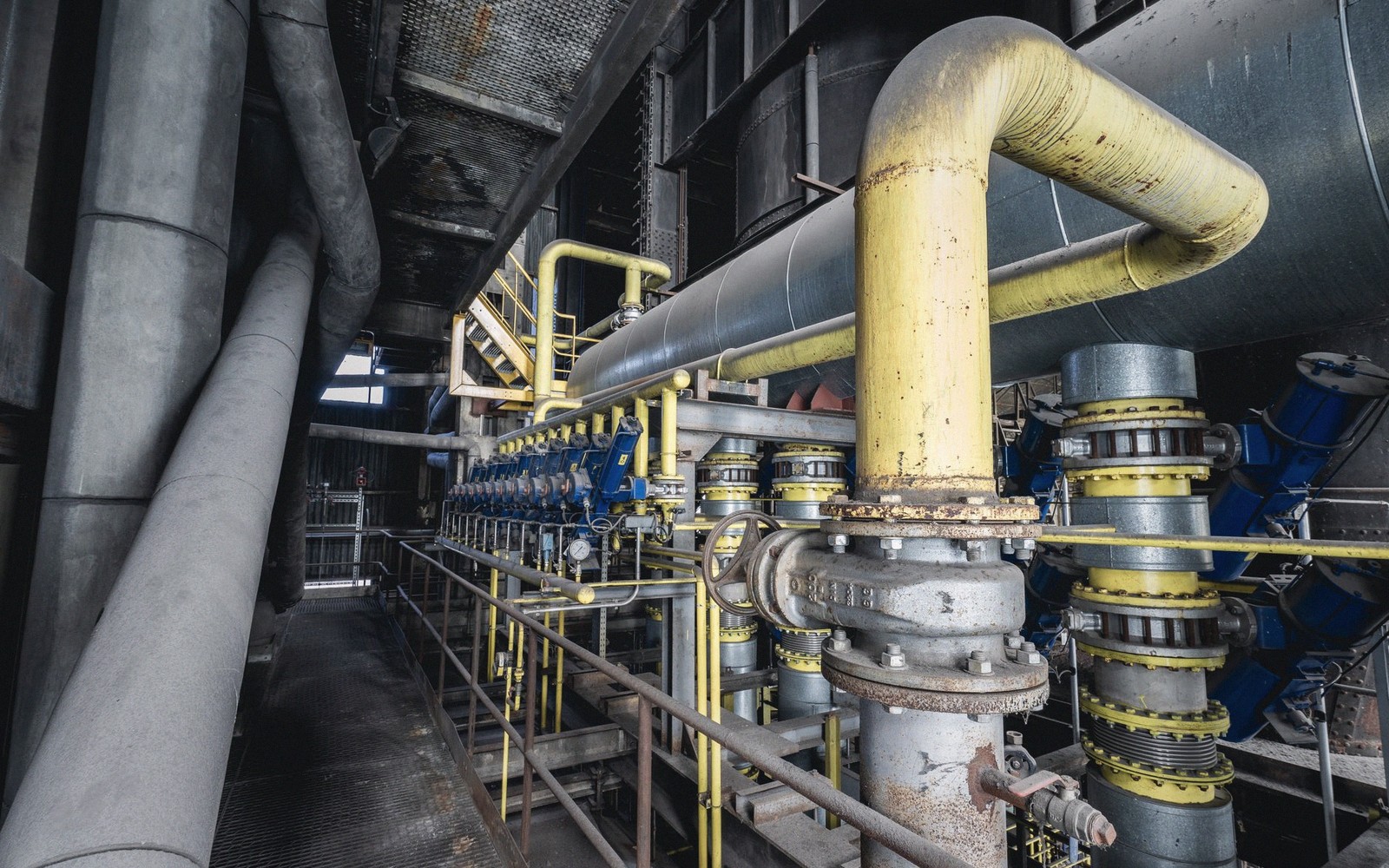
01Steel in the ground, steel on the water
Energy infrastructure is, at its core, a problem of physics: get a molecule from where it is abundant to where it is needed, as cheaply and reliably as possible. The solutions humanity has built to do this — pipelines, tankers, storage tanks, and terminals — form a vast, mostly invisible system that touches every corner of the modern economy.
Pipelines are the workhorse of the network. Onshore, they run for tens of thousands of miles across continents, moving crude oil from production basins to refineries, and refined products from refineries to distribution hubs. Natural gas travels almost entirely by pipeline within continents — compressed and pushed by compressor stations spaced at regular intervals along the route. Offshore, subsea pipelines connect deepwater platforms to shore, sometimes running hundreds of miles along the seabed. What makes pipelines attractive is their economy: once built, they move enormous volumes at low marginal cost. What makes them constraining is their permanence — a pipeline locks in a specific origin and destination, and building a new one requires years of engineering, permitting and capital.
Where pipelines cannot reach — across oceans, between continents — tankers take over. Crude tankers range from modest coastal vessels up to the largest ships afloat, the VLCCs (Very Large Crude Carriers) and ULCCs (Ultra Large Crude Carriers) that carry millions of barrels per voyage. The tanker market is genuinely global: a cargo lifted in the Middle East can be redirected mid-voyage to a refinery in Asia or Europe depending on where prices move. This flexibility is one reason tanker freight rates are so volatile — demand for ships spikes whenever trade routes lengthen or geopolitical disruption forces cargoes to travel further. Product tankers, somewhat smaller, carry refined fuels rather than crude, and their movements trace the geography of where refining capacity and consumption are mismatched.12
02Terminals, tanks, and the role of storage
Between the pipeline and the tanker, and between the tanker and the refinery, sits storage — the buffer that keeps the system from seizing up. Tank farms cluster around ports, refineries, and pipeline junctions: vast arrays of cylindrical steel tanks holding crude or products while markets clear, ships load, or refineries schedule their runs. The world's major trading hubs — Rotterdam in Europe, Cushing in Oklahoma, Fujairah in the UAE — are defined largely by their storage and terminal infrastructure. Cushing, a landlocked junction in the middle of the United States, matters to global oil markets not because of local geology but because it is the designated delivery point for the WTI futures contract, making its inventory figures a market-moving data point every week.
Terminals are the interfaces between modes of transport: import and export terminals allow crude or products to pass from pipeline to ship or back again. For natural gas, the equivalent infrastructure is the LNG terminal — a facility that either liquefies gas for export or receives and re-gasifies it for domestic distribution. These terminals are enormously capital-intensive and take years to permit and construct, which is why the global LNG trade develops in long cycles rather than responding nimbly to short-term price signals.3
Strategic petroleum reserves — government-held stocks maintained for supply emergencies — add another layer to the storage picture. The United States holds its Strategic Petroleum Reserve in salt caverns along the Gulf Coast, a geological formation that is both secure and, because of the caverns' natural pressure, relatively cheap to maintain.
Infrastructure creates chokepoints as surely as it creates connectivity.
03The invisible chokepoints
Infrastructure creates chokepoints as surely as it creates connectivity. A handful of maritime straits — Hormuz, Malacca, the Turkish Straits — carry a disproportionate share of the world's seaborne energy trade. A single pipeline failure or a congested terminal can ripple into supply disruptions hundreds of miles away. This physical fragility is a structural feature of the energy system, not a bug that engineering has yet to fix. The network is extensive, but it is not redundant, and the molecules still have to move.
Key players & places