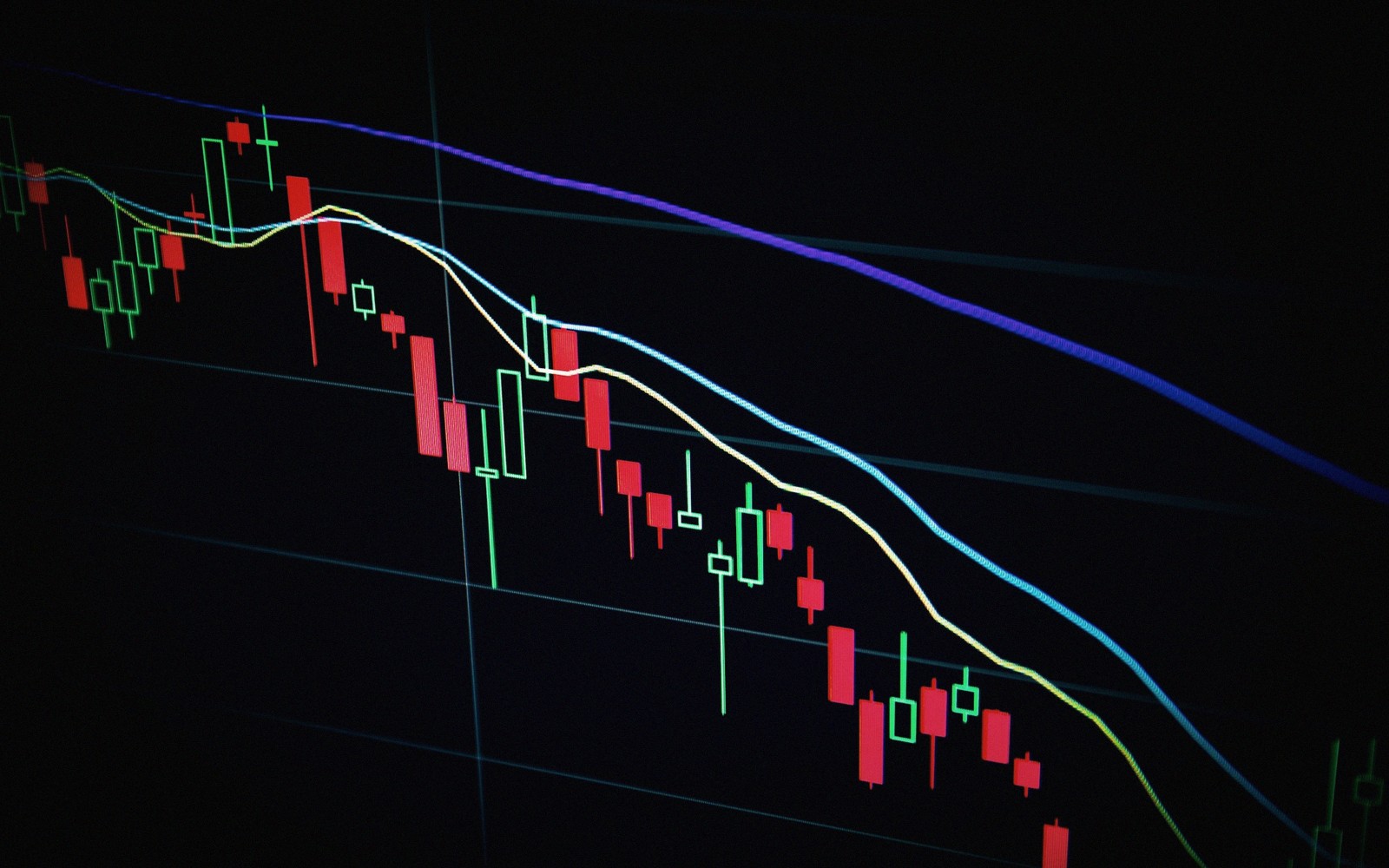
01The Price Nobody Fully Controls
Open any financial data feed and the crude price is right there, updating by the second. It looks like a single number. It isn't — not really. What the ticker shows is the current equilibrium between dozens of forces tugging in opposite directions: geopolitics and geology, weather and warehouses, algorithms and anxiety. Understanding why the price moves means learning to read those forces, not just the number itself.
Oil is traded globally but priced in benchmarks — principally Brent crude, drawn from the North Sea and used as the reference for most of the world's internationally traded oil, and WTI (West Texas Intermediate), the American benchmark settled at Cushing, Oklahoma. Both move in roughly the same direction at roughly the same time, because they ultimately price the same underlying reality: the global balance of supply and demand for a commodity the world cannot yet do without. When that balance shifts — even by a fraction — the price moves sharply, because oil markets have almost no slack.1
02Supply, Demand and the Thin Margin Between Them
Start with the fundamentals. On the demand side, the world consumes an enormous quantity of crude every day, and that consumption tracks the rhythm of the global economy closely. When factories hum, freight moves and airlines fill seats, demand rises. When a major economy slows, contracts or locks down, it falls. Because oil underpins transport, manufacturing and petrochemicals, a broad economic slowdown shows up fast in the demand signal — and traders price that expectation in before the slowdown fully arrives.
Supply is a slower, knottier story. Wells do not switch on and off like taps; producing fields decline gradually as reservoir pressure falls. New supply takes years of planning, drilling and infrastructure before a single barrel reaches market. This asymmetry — demand can shift in weeks, supply adjusts in years — creates persistent tension in the price. When demand surges, producers cannot instantly respond. When demand collapses, they cannot shut in production quickly without incurring costs and risking damage to reservoir integrity. The price, caught between a fast-moving demand and a slow-moving supply, often overshoots in both directions.
What sharpens that overshooting is how thin the margin between supply and demand actually is. The world consumes oil relentlessly, and the buffer — the excess productive capacity sitting idle, ready to be switched on — is historically narrow. Spare capacity is the quiet number that determines how much insurance the market actually holds. When that buffer is large, the market can absorb a supply disruption without panic. When it is thin — as it periodically becomes during demand booms or supply crunches — even a modest outage somewhere in the world can send the price lurching upward, because there is little slack to absorb the shock.2
Between them, these nations hold a substantial share of global spare capacity and a large portion of proved reserves.
03The OPEC+ Variable
Into this already volatile system insert a political dimension: OPEC and, since the mid-2010s, the broader OPEC+ alliance that brought Russia and other non-OPEC producers into coordinated production decisions. Between them, these nations hold a substantial share of global spare capacity and a large portion of proved reserves.
When OPEC+ acts in concert to cut production, it deliberately tightens the supply-demand balance and pushes the price higher — in theory. In practice, the outcome depends on compliance, because member nations each have their own fiscal pressures and domestic incentives to overproduce relative to their agreed quota. Markets watch compliance statistics closely; a production cut announced with fanfare but poorly observed is a much weaker price signal than one where the barrels visibly disappear from supply data.
OPEC+ also faces a structural complication it did not have to reckon with a generation ago: the rise of shale production, particularly from the Permian Basin and other tight-rock plays in the United States. American shale producers are price-takers, not price-setters — they respond to the price rather than setting it — but collectively they constitute a large, relatively flexible supply source. When OPEC+ cuts and the price rises, shale economics improve, rigs are added, and US production climbs to capture the higher price. This limits how much the cartel can sustainably lift the price without calling more barrels into existence from outside its membership. The equilibrium is dynamic, not fixed.
04Sentiment, Futures and the Reflexivity of the Market
Fundamentals — barrels in and barrels out — explain the broad direction of the price over months and years. They explain much less well why the price might move two or three percent in an afternoon. That shorter-term volatility lives in a different dimension: market sentiment, positioning and the mechanics of futures trading.
Oil is traded almost entirely through futures contracts — standardised agreements to deliver a specified quantity of crude at a future date and price. The futures market allows producers to hedge their revenue and buyers to lock in costs, but it also draws in financial participants — funds, banks, algorithmic traders — whose positions are driven by expectations, risk appetite and momentum rather than by the need to take physical delivery of a barrel. When sentiment turns bullish, financial buyers pile in; prices run ahead of physical fundamentals. When sentiment sours, those positions unwind rapidly, and the price can fall faster than any change in the underlying supply-demand picture would warrant.3
This reflexivity — prices moving partly because participants expect them to move — is not a malfunction; it is a feature of liquid futures markets. But it means that the crude price at any given moment contains two signals layered on top of each other: a slow, fundamental signal about real-world supply and demand, and a fast, sentiment-driven signal about what traders think is coming next. Separating them requires looking at multiple indicators: inventories, rig counts, tanker tracking data, economic forecasts. No single number tells the whole story.
05Geopolitics, Weather and the Unexpected
The forces above operate more or less continuously. Then there are the shocks — events that arrive suddenly and reroute the calculation entirely.
Geopolitical disruptions have moved the oil price repeatedly across decades: conflicts in producing regions, sanctions that strand barrels, infrastructure attacks that take production offline. What distinguishes a price-moving geopolitical event from mere noise is whether it actually affects — or credibly threatens to affect — the physical flow of barrels. A conflict far from producing infrastructure may stir headlines without moving supply; a strike on a major export terminal, a blockade of a critical shipping strait or sanctions targeting a significant producing country can genuinely alter the supply picture, and the price responds accordingly.
Weather adds its own volatility. Hurricanes in the Gulf of Mexico can shut in offshore production and shutter refining capacity simultaneously. Cold snaps drive sudden spikes in heating fuel demand. Droughts can disrupt hydropower in ways that redirect energy demand toward fossil fuels. None of these are foreseeable with useful precision, which is precisely why they move prices: markets hate uncertainty, and sudden uncertainty about supply or demand gets priced in immediately.
06Reading the Price
The crude price, then, is not a verdict on the world — it is a running vote, cast by millions of participants, on where supply and demand are headed, filtered through the lens of current sentiment and punctuated by unexpected events. Understanding it means holding several frames simultaneously: the long, slow tide of fundamental supply and demand; the medium-term politics of producer coordination; and the short-term turbulence of positioning, sentiment and surprise.
No single model predicts the price reliably over any useful horizon. What clarity is available comes from watching the indicators closest to the physical market — inventory levels, spare capacity estimates, production data — while keeping one eye on the sentiment signals that tell you how quickly, and in which direction, traders are positioned to react when the unexpected, inevitably, arrives.
Key players & places